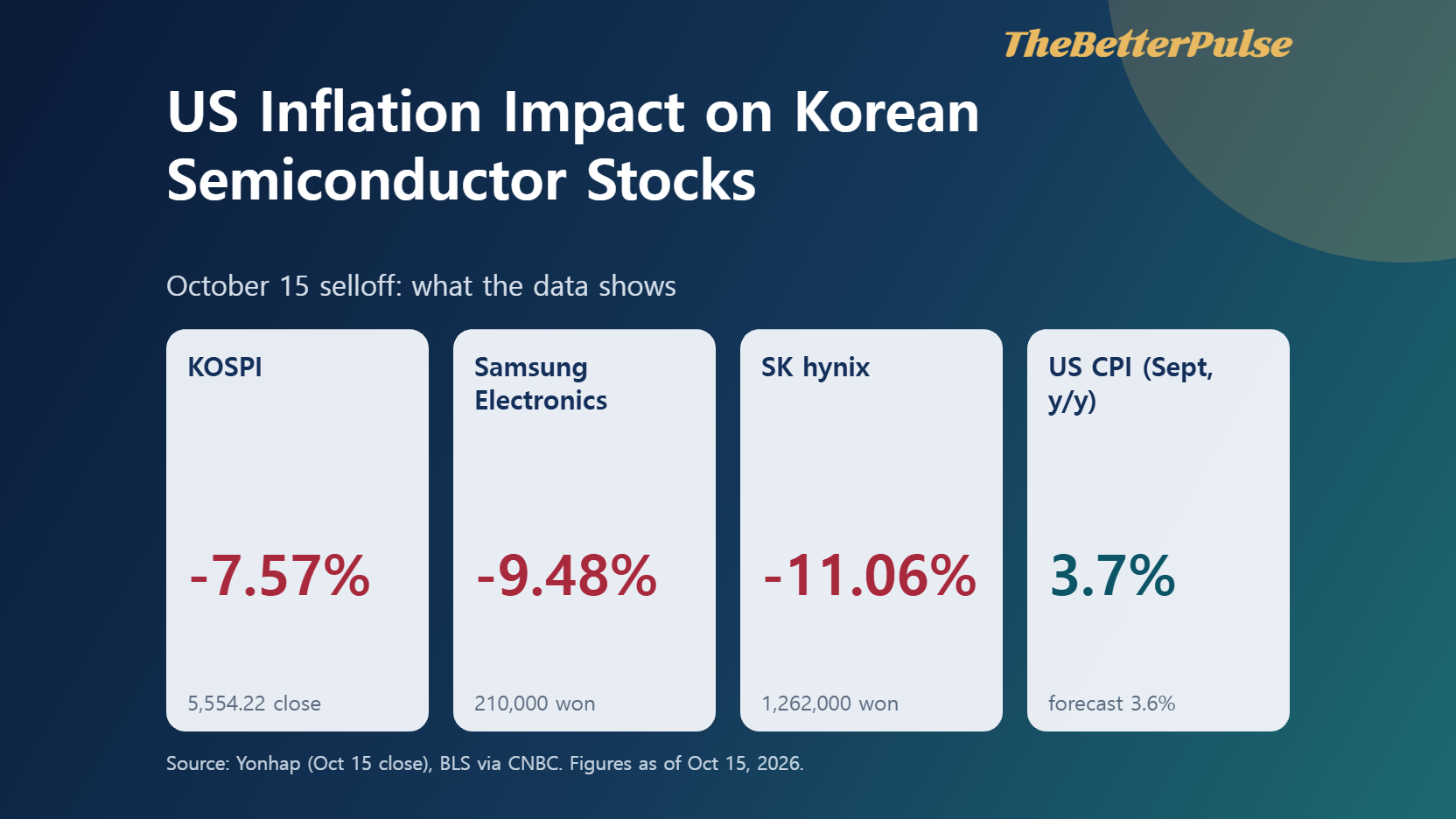
On October 15, South Korea’s benchmark KOSPI index closed 7.57% lower at 5,554.22, while Samsung Electronics fell 9.48% and SK hynix fell 11.06%. The US inflation impact on Korean semiconductor stocks was one trigger behind that move, because the US September CPI report arrived hotter than forecast the day before, but it was not the only one. This article separates what is confirmed from what is interpretation, then gives you three indicators and a short checklist to use before you make any decision. It does not recommend buying or selling any security.
If you hold Korean chip exposure through local shares, ADRs or funds, you carry three risks at once: US interest rates, the profitability of AI spending, and the Korean won. Each one can move the price you see on your screen, and they often move together.
What Happened on October 15: The Confirmed Numbers
Closing figures below come from Yonhap News Agency’s report on the regular session, citing the Korea Exchange. Some data aggregators show a slightly different KOSPI close, so this article uses the Yonhap regular-session figures throughout.
| Measure | October 15 result | Context |
|---|---|---|
| KOSPI | 5,554.22 (-7.57%) | Largest one-day fall since July 28 (-10.84%); lowest close since April 7 |
| KOSPI intraday low | 5,450.81 (-9.29%) | The index recovered above 5,500 by the close |
| KOSDAQ | 760.82 (-7.65%) | Fell below 800 |
| Samsung Electronics | 210,000 won (-9.48%) | Down 66,000 won (24%) over seven sessions |
| SK hynix | 1,262,000 won (-11.06%) | Down 579,000 won (31%) over seven sessions |
| Foreign investors, KOSPI | Net sold 3.634 trillion won | Eighth straight session of net selling |
| USD/KRW | 1,344.6 (+6.3 won) | Seoul FX market, 3:30 p.m. |
| Sector moves | Electrical and electronics -10.13% | Pharmaceuticals +2.65%, food and tobacco +2.05% |
Both markets also triggered Level 1 circuit breakers, which halt trading for 20 minutes after an index stays down 8% or more for one minute. It was the first time both markets were halted on the same day since July 29. Over seven straight sessions, KOSPI lost 1,449.52 points, or 20.7%, from its October 2 close of 7,003.74 (the percentage is my calculation from Yonhap’s point figures).

The US inflation impact on Korean semiconductor stocks: What the Data Shows
On October 14, the US Bureau of Labor Statistics reported that consumer prices rose 3.7% from a year earlier in September, up from 3.4% in August and above the 3.6% consensus. Prices rose 0.6% on the month. Core CPI, which excludes food and energy, rose 0.3% on the month and 2.6% on the year, against forecasts of 0.2% and 2.5%. Gasoline rose 9.1% and accounted for more than half of the monthly increase. CNBC and InvestmentNews both noted that price pressure was spreading beyond energy.
Why does that matter for Korean chip stocks? The Federal Reserve raised its target range to 3.75%-4.00% on September 16, its first hike since 2023, in a 12-0 vote. The Fed’s September projections put the median federal funds rate at 4.1% at the end of 2026, which points to about one more quarter-point hike if projections hold. A hot inflation print raises the odds of that hike, and higher-for-longer rates raise the financing cost of AI data centers.
Market odds are unsettled. After the CPI release, CNBC cited about a 54% chance of an October hike on CME’s FedWatch tool and InvestmentNews cited 51.5%, while Financial Express reported a 65% chance of a pause. Check the live tool rather than relying on any single number.
Here is a simple calculation. The midpoint of the Fed’s range is 3.875%. Subtract 3.7% headline inflation and the real policy rate is only about 0.2 percentage points; against 2.6% core inflation it is about 1.3 points. This is a rough comparison, not an official measure, but it shows why investors worry that policy is not far above inflation.
The size of the Korean move shows that inflation alone does not explain it. The S&P 500 fell 1.11% and the Nasdaq fell 1.88% in the preceding US session, while KOSPI fell 7.57%, about four times the Nasdaq’s decline (7.57 divided by 1.88). Reports attribute the rest to doubts about AI profitability, expanded Chinese memory supply and heavy foreign selling. Nobody can measure exactly how much came from inflation, so treat the US inflation impact on Korean semiconductor stocks as one factor among several.
AI Investment Risks and the China Memory Factor
Yonhap reported that Gartner expects about $1 trillion of AI infrastructure spending in 2026 and roughly $6 trillion more across 2027 to 2030. To earn an adequate return after investment and financing costs, Gartner estimated that about $8.5 trillion of revenue would be needed by 2030, while data-center-related revenue could reach at most $3.6 trillion. The difference is about $4.9 trillion, or 58% of the required revenue (my calculation). That is a forecast, not a fact, and it can narrow if AI revenue grows faster than expected. This is where the US inflation impact on Korean semiconductor stocks meets the AI debate: higher rates raise the cost of the financing those projects need.
Memory supply is the second risk. China’s CXMT said on October 10 that it plans to unveil a server DDR5 module using a 4F² cell design before the end of 2026, without disclosing capacity, performance or a mass-production date. Experts quoted by Seoul Economic Daily said an announcement is not mass production: one professor expects meaningful volume no earlier than the end of 2027, and some experts estimate initial yields below 10%. Samsung’s chief technology officer also said the company is developing 4F² technology. Markets still reacted: the Philadelphia Semiconductor Index fell 2.67% on October 12, and Samsung and SK hynix fell about 5% to 6% in early trading on October 13.
| Confirmed | Interpretation or forecast |
|---|---|
| US CPI 3.7%, core 2.6%, above forecasts | The Fed may hike again in October or December |
| KOSPI -7.57%, chip leaders -9% to -11% | Inflation was the main cause (not provable) |
| CXMT announced a plan for a new DRAM product | It will take market share soon (experts doubt it) |
| Gartner published a revenue gap estimate | AI spending will slow (depends on revenue growth) |
What a Rebound Would Require, and What the Won Adds
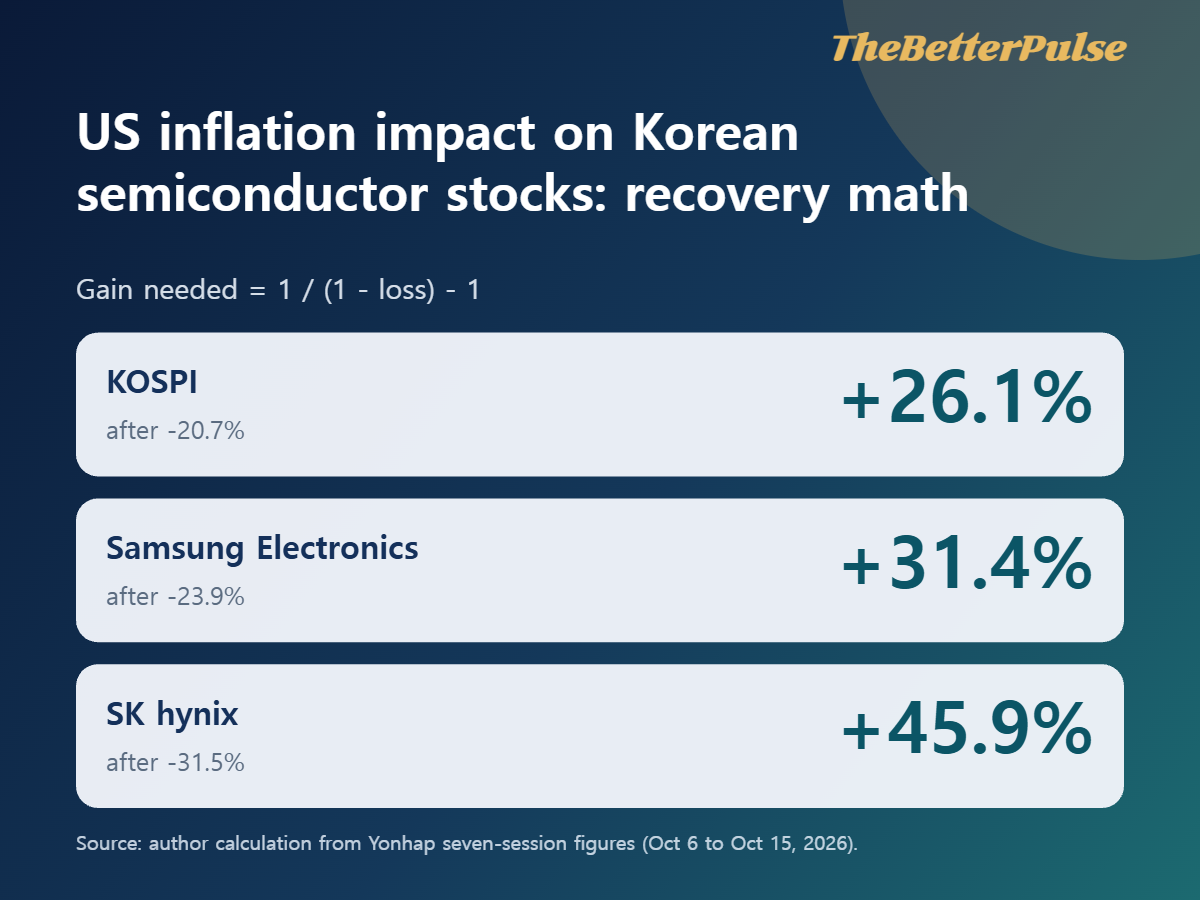
A fall of any size needs a larger gain to recover. The formula is: required gain = 1 / (1 – loss) – 1. Using the seven-session falls reported by Yonhap:
| Instrument | Seven-session fall | Gain needed to recover |
|---|---|---|
| KOSPI | -20.7% | +26.1% |
| Samsung Electronics | -23.9% | +31.4% |
| SK hynix | -31.5% | +45.9% |
Currency adds another layer for dollar-based investors. Assume, for illustration only, a $100,000 position in a stock that fell 9.48% like Samsung did on October 15. The won weakened 0.47% against the dollar that day (1,338.3 to 1,344.6), so the dollar value fell about 9.9%, a loss near $9,900 rather than $9,480. If the won had strengthened instead, the dollar loss would have been smaller. Whether you hedge the currency is therefore part of your risk, not a detail.
Three Indicators to Monitor Before You Act
To judge whether the US inflation impact on Korean semiconductor stocks is fading or growing, watch these three indicators rather than daily price swings.
| Indicator | Relief signal | Pressure signal | Where to check |
|---|---|---|---|
| 1. US core inflation and Fed pricing | Core CPI cools and hike odds fall before the October 27-28 FOMC meeting | Core stays at or above 0.3% monthly and December hike odds rise | BLS CPI release, CME FedWatch, Fed calendar |
| 2. Memory supply evidence | CXMT shows no volume, low yields or no customer qualification; Samsung and SK hynix guide for firm demand | CXMT discloses specs, samples or customers; chipmakers warn on pricing | Company announcements, third-quarter earnings calls |
| 3. AI spending versus revenue | Big Tech capex plans hold while AI revenue grows | Capex cuts, or financing stress for data-center projects | Big Tech earnings, Gartner-type forecasts, bond yields |
For the first indicator, September PCE inflation, the Fed’s preferred gauge, is due later this month according to CNBC. For the second, check each company’s own investor relations calendar for third-quarter earnings dates, because published dates varied by source. For the third, remember that the Gartner figures above are a forecast and can be revised.
A Short Checklist for International Investors
- Write down your real exposure in dollars: local shares, ADRs or funds, and the share of semiconductors inside each fund.
- Use the recovery table to decide your loss tolerance before the next move, not during it.
- Decide whether you hedge the won, and know the cost of doing so.
- Check how trading halts and circuit breakers affect your broker’s execution and local market hours.
- Mark the dates: Bank of Korea rate decision on October 22, FOMC on October 27-28 and your holdings’ earnings dates.
What This Means for Your Next Step
What you gain from this analysis is a way to separate a trigger from a cause. The US inflation impact on Korean semiconductor stocks is real, but the data also point to AI spending doubts, possible Chinese supply and heavy foreign selling. Conditions are more favorable for investors who hold Korean chip exposure as a small, planned part of a diversified portfolio, understand their currency exposure and can wait. They are less favorable for anyone using leverage or needing the money soon, because a seven-session fall of 21% to 31% shows how fast losses can build, and a rebound needs a larger gain than the fall. Prices after the October 15 close will differ, so check current quotes first. Your first step is simple: calculate your dollar exposure and the gain you would need to recover from a further 10% fall, then compare it with what you can tolerate.
Disclaimer
This article reflects the author’s personal and subjective views and is provided for information only. It is not investment advice or a recommendation to buy or sell any security. Figures are as of the October 15, 2026 close unless noted and may change. The final decision, and responsibility for the outcome, rests with you. AI tools assisted with drafting, and the images are charts built from the cited figures.
Related Reading
코스피 급락, 지금 팔아야 할까? (Korean)
중국 D램 추격, 삼성·SK 영향은? (Korean)
Sources and Official References
Official sources:
- U.S. Bureau of Labor Statistics, Consumer Price Index (September 2026 release)
- Federal Reserve, FOMC statement, September 16, 2026
- Federal Reserve, Summary of Economic Projections, September 2026
- Federal Reserve, FOMC meeting calendars
- Bank of Korea, 2026 Monetary Policy Board meeting schedule (PDF, in Korean)
News reports:
- Yonhap News Agency, KOSPI and KOSDAQ close, October 15, 2026 (in Korean)
- CNBC, September 2026 CPI report
- InvestmentNews, core inflation and October Fed hike odds
- The Financial Express, US inflation tops forecasts
- Seoul Economic Daily, CXMT touts next-generation DRAM with no specs or launch date
- Seoul Economic Daily, Samsung and SK hynix tumble as China memory threat spooks investors
#USInflation #KoreanSemiconductorStocks #KOSPI #AIInvestmentRisk #SamsungElectronics