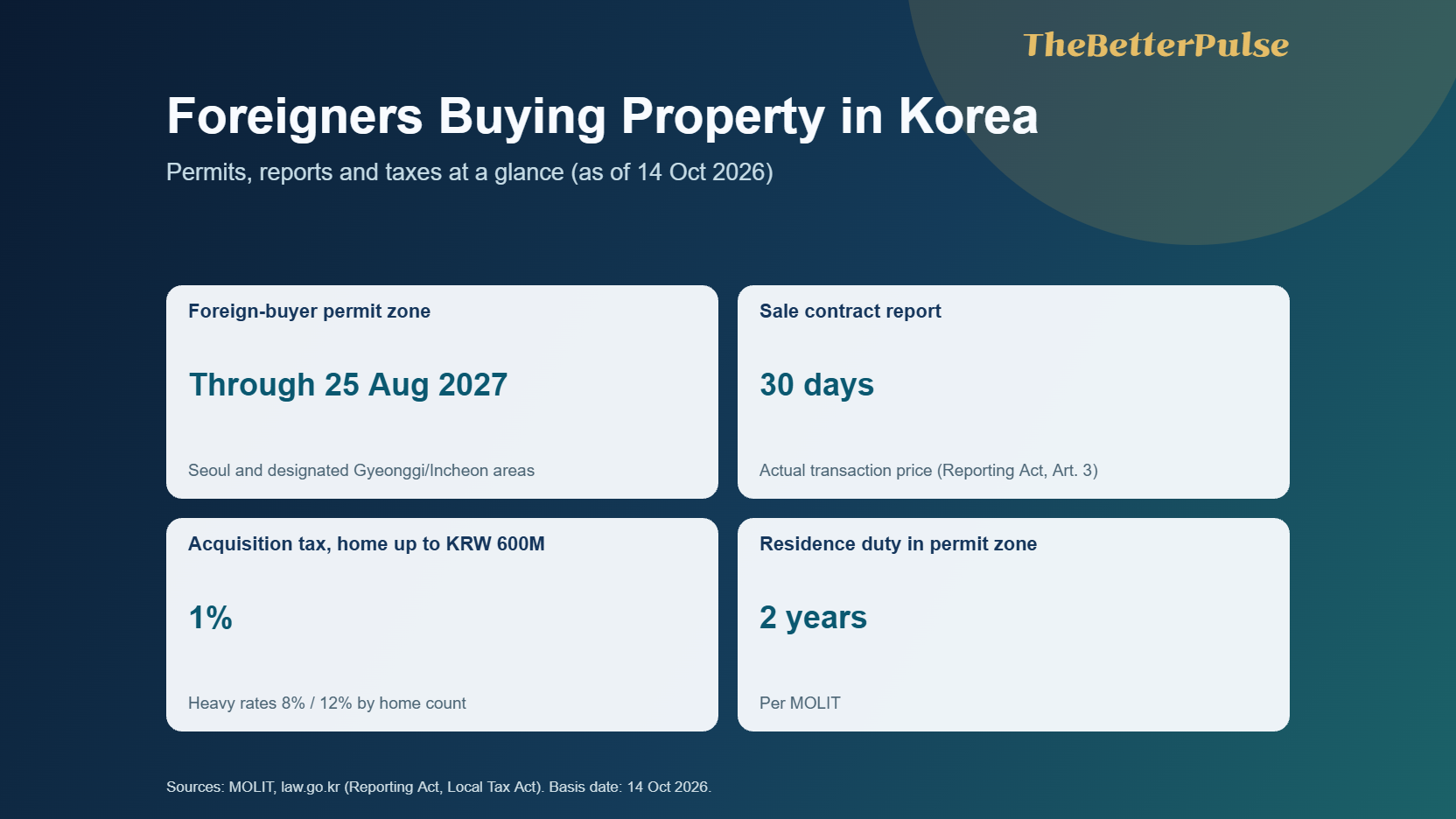
Foreigners Buying Property in Korea is legal in principle, but the rules tightened sharply in 2025 and 2026, and signing in a permit zone before approval can leave the transaction without legal effect. This independent English overview, based on official Korean sources I opened on 14 October 2026, covers who can buy, where permission is needed, reporting deadlines, taxes and fees, and a hypothetical cost example. It is general information, not legal or tax advice.
Who can buy and where the limits are
The Act on Report on Real Estate Transactions has no general nationality ban. A “foreigner, etc.” means an individual without Korean nationality, a foreign-law corporation, certain companies at least half owned or run by such persons, a foreign state or an international organization. For land in military facility protection zones, designated cultural heritage areas, ecological and landscape conservation areas or wildlife special protection areas, Article 9 requires permission before signing. A contract made without it has no effect, and the 2024 text allows up to two years in prison or a KRW 20 million fine.
Foreigners Buying Property in Korea: the 2025-2026 permit zones
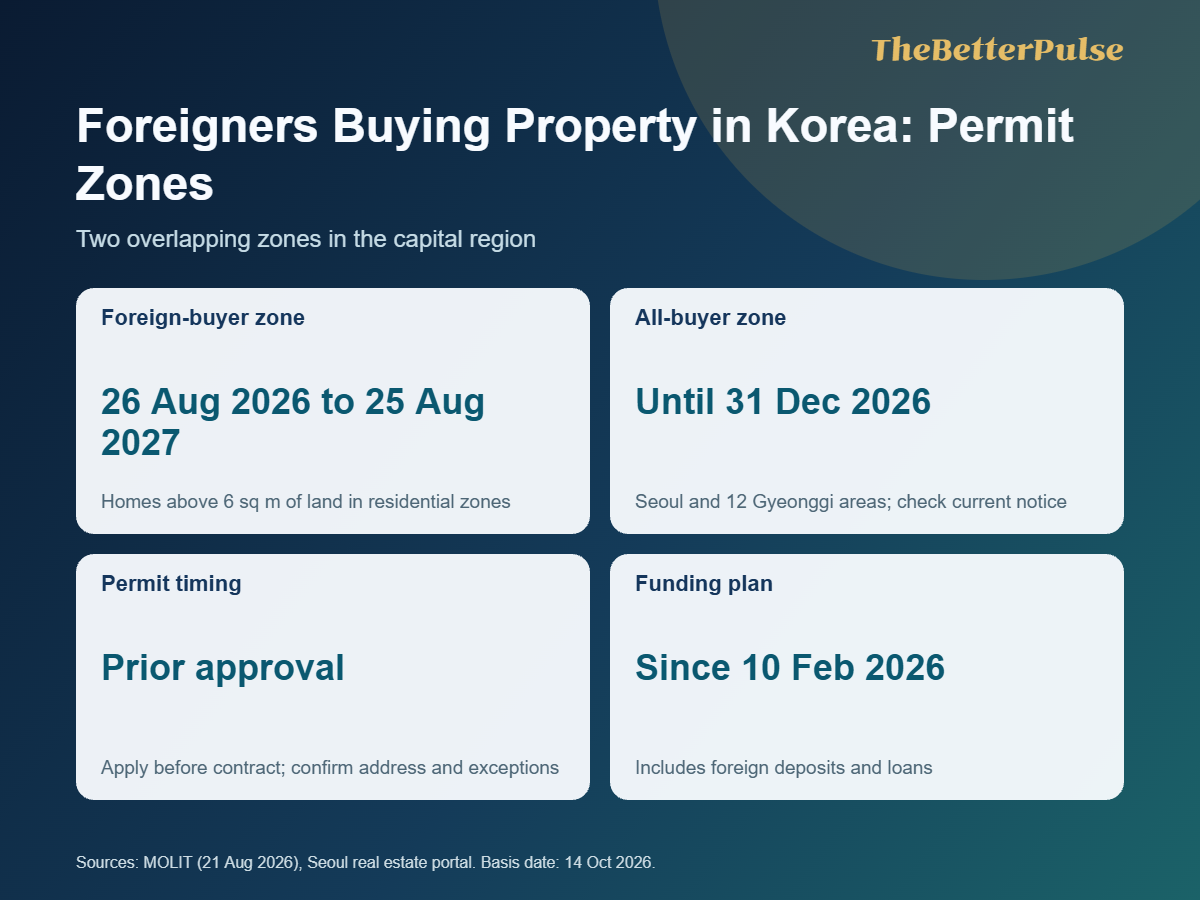
The biggest change is the foreign-buyer land transaction permit zone. The Ministry of Land, Infrastructure and Transport (MOLIT) designated it on 26 August 2025 and, on 20 August 2026, renewed it from 26 August 2026 to 25 August 2027 with the same scope: all of Seoul, 23 Gyeonggi cities and counties, and nine Incheon districts. It covers detached, multi-family, row and multi-unit houses and apartments where the land area exceeds 6 square meters in residential zones or 15 square meters in commercial zones. Check the parcel and building type before relying on these thresholds. You need the permit before the contract, and MOLIT says permit holders must live in the home for two years after acquiring it.
Outside the capital region, MOLIT separately designated 353 outer-island areas as foreign-buyer land transaction permit zones on 20 August 2026 for national-defense reasons. A foreigner must get permission from the relevant city, county or district before contracting for land in a designated parcel. This is separate from the metropolitan housing permit described above; do not assume its two-year residence duty or housing thresholds apply to every island parcel. Check the official parcel notice and the local authority.
A separate land-transaction permit zone applies regardless of nationality. A 15 October 2025 MOLIT notice set its period from 20 October 2025 to 31 December 2026 across Seoul and 12 Gyeonggi areas. It generally covers apartments, plus specifically listed mixed-use apartment complexes containing row or multi-unit homes. It has a two-year residence duty, subject to applicable exceptions. Check the parcel and current notice at the local ward office; a later extension has not been confirmed here.
Since 10 February 2026, foreign buyers have had to include visa status, address and whether they reside in Korea for 183 days or more in the transaction report. Permit-zone buyers also submit a funding plan and supporting documents, including details of foreign deposits, loans and banks. MOLIT additionally requires copies of the signed sale contract and evidence of the deposit payment for sale contracts signed from that date, regardless of nationality.
Reporting deadlines for Foreigners Buying Property in Korea
- Sale contract: the parties, or the licensed broker, report the actual price within 30 days of the contract (Article 3).
- Other acquisition contracts: a foreigner reports within 60 days (Article 8(1)).
- Inheritance, auction and similar causes: report within six months (Article 8(2)).
- Acquisition tax: file and pay within 60 days of acquisition (Local Tax Act, Article 20).
Late or false reporting can trigger penalties; confirm the current sanction and amount with the local authority before relying on an older translation.
Foreign exchange reporting for funds from abroad
The Bank of Korea says a non-resident buying with funds carried or remitted from abroad reports to a designated foreign exchange bank with documents proving the deal. If the money was not remitted from abroad, or includes Korean-raised funds such as a lease deposit or a Korean bank loan, the report goes to the Bank of Korea (Regulation Article 9-42). Bringing in more than USD 10,000 in cash must also be declared to Korea Customs. Residency for exchange purposes is a separate question, so ask your bank.
Registration, brokerage fee and loans
Check the register first through the Supreme Court Internet Registry. Ask a judicial scrivener or registry office which identification number and supporting documents your residency status requires for title registration. Seoul caps the brokerage fee on a home sale at 0.4 percent for KRW 200 million to under 900 million, and 0.5 percent from 900 million to under 1.2 billion.
On loans, the Financial Services Commission announced tighter regulated-area loan-to-value and price-tier caps in October 2025. Those policy limits are not a promise of credit and may have changed since then. Ask a lender for the rules currently applicable to the address, price, income, debt and your residence status; I could not confirm eligibility for a particular visa category from an official source.
Taxes while you own
The Local Tax Act, effective 1 July 2026, sets acquisition tax on a purchased home at 1 percent up to KRW 600 million, a sliding 1 to 3 percent up to 900 million, and 3 percent above. Heavy rates apply by home count: 8 percent for a second home in an adjustment area, or a third elsewhere, and 12 percent for a third in an adjustment area, or a fourth elsewhere. The text has no nationality test, and the Ministry of the Interior and Safety says a household includes family listed with you on resident or foreigner registration records.
Annual property tax and any comprehensive real estate holding tax depend on ownership as of 1 June, official assessed values and applicable deductions. I did not verify all 2026 tax-law changes or each buyer’s qualification, so ask a Korean tax professional to calculate them rather than treating an older rate table as current.
Selling and renting as a non-resident
The Income Tax Act taxes non-residents’ gains on Korean property the same classified way as residents. Older NTS guidance says the usual one-home exemption generally does not apply to non-residents, but describes an exception for a former resident selling within two years after leaving Korea. It also distinguishes the usual long-term holding deduction from the resident one-home deduction. Do not infer a 2026 tax bill from this 2019 guide. Confirm residence status, exemption, deductible holding period, withholding duty and current surcharges with a Korean tax adviser before a sale. Non-residents can owe Korean tax on Korean-source rental income; confirm the reporting method and any withholding for your specific lease with a tax adviser.
Overseas Koreans and F-4 holders
Overseas Korean status is not a reason to skip the address check, transaction report or foreign-exchange review. A domestic residence report and F-4 status may affect which identification and property rules apply. I could not verify a categorical exemption from the capital-region foreign-buyer permit for F-4 holders; ask the ward office and a Korean lawyer before signing.
Key rules at a glance
The table below condenses the main rules for Foreigners Buying Property in Korea as of 14 October 2026.
| Item | Rule | Source, date |
|---|---|---|
| Eligibility | No nationality ban; protected zones need prior permission | Reporting Act, Art. 9 |
| Foreign-buyer permit zone | Seoul, 23 Gyeonggi, 9 Incheon districts to 25 Aug 2027 | MOLIT, 21 Aug 2026 |
| Sale report | 30 days, with actual price | Reporting Act, Art. 3 |
| Funds from abroad | Report to an exchange bank or the Bank of Korea | Bank of Korea FAQ |
| Acquisition tax | 1% to 3% by price; 8% or 12% heavy rates | Local Tax Act, Jul 2026 |
| Non-resident gains | One-home exemption generally unavailable; exceptions and deductions require individual review | NTS guidance (2019), verify current law |
Common mistakes
- Signing before the permit is issued.
- Skipping the foreign exchange report or the funding plan details.
- Assuming a permit-zone home can be rented without checking the applicable residence duty and any exception.
Step-by-step checklist for Foreigners Buying Property in Korea
- Check the address against both permit zones and protected-area limits.
- Ask your bank which exchange report applies.
- Apply for the permit before signing, with the funding plan.
- Sign, retain the contract and deposit-payment evidence, then file the 30-day sale report with the local government through MOLIT’s Real Estate Transaction Management System (RTMS) or the licensed broker. Check the applicable authentication and required attachments.
- Pay the balance, register title and file acquisition tax within 60 days.
Hypothetical cost example
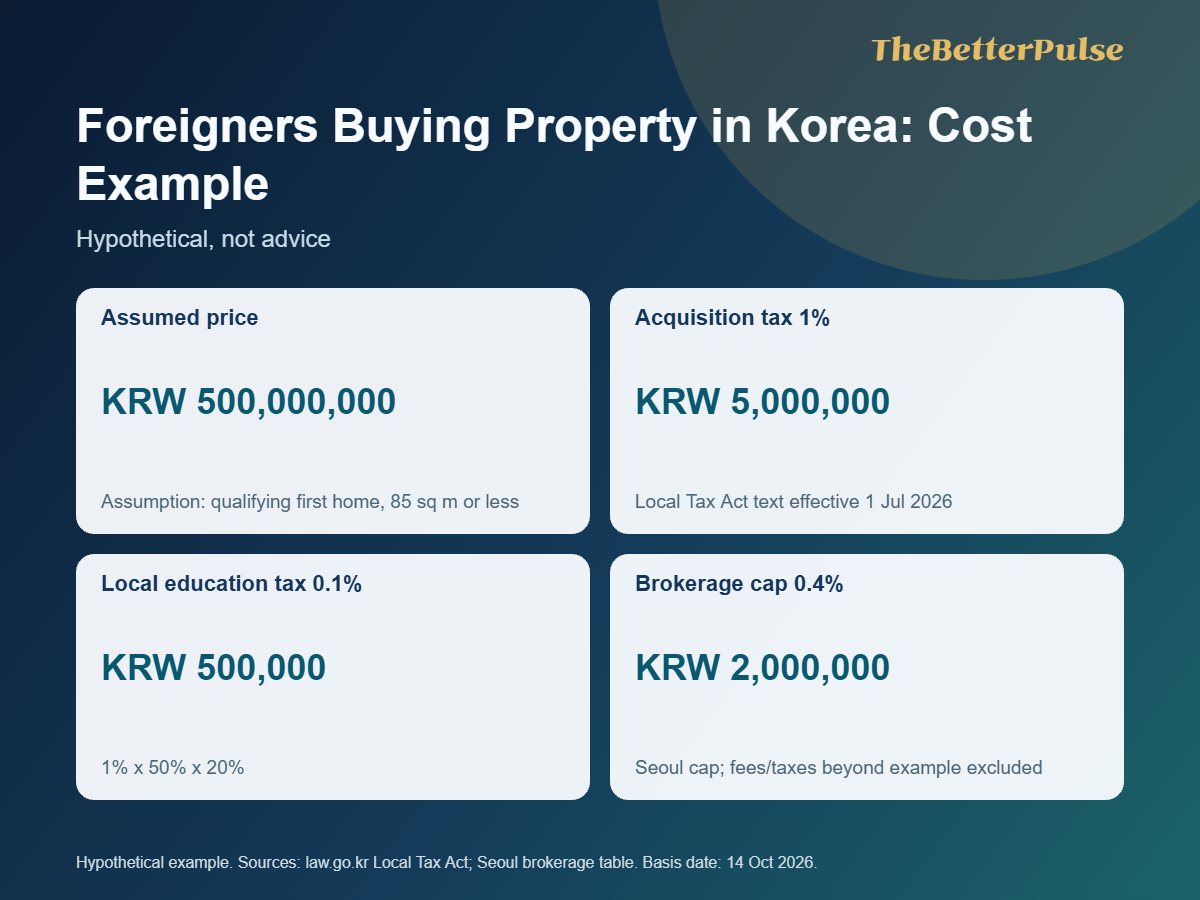
This is a hypothetical illustration, not advice. Assume a foreign national with a valid permit buys a first home, a KRW 500,000,000 apartment of 85 square meters or less. Formula: price x (1% acquisition tax + 0.1% local education tax + 0.4% brokerage cap). Rates come from the Local Tax Act text effective 1 July 2026 and Seoul’s brokerage table, read on 14 October 2026. Local education tax is 1% x 50% x 20% = 0.1%.
- Acquisition tax: KRW 5,000,000
- Local education tax: KRW 500,000
- Brokerage at the cap: KRW 2,000,000
- Total: KRW 7,500,000, or 1.5% of the price
This estimate excludes VAT on the brokerage fee, registration costs, annual property taxes, financing costs and any farm special tax. A different ownership count or regulated-area status can trigger a much higher acquisition-tax rate, so recalculate the entire bill with a tax professional rather than adding a simple surcharge to this example.
What this means for you
For Foreigners Buying Property in Korea, the benefit is access to owner-occupied homes with predictable costs, provided you follow the order: permit, contract, reports, payment, registration. The favorable conditions are a home meeting the permit conditions, a documented funding source and, for the illustrative 1% acquisition-tax scenario, a qualifying first purchase at or under KRW 600 million. The risks are a void contract, fines, heavy tax rates and rules that may change by year end. A sensible first step is to check the address against the permit-zone lists, then consult a certified tax accountant and a judicial scrivener.
These are my personal and subjective views, offered for information only. I promise no result and urge no purchase. The final decision and responsibility rest with you, so confirm everything with a licensed lawyer, certified tax accountant or judicial scrivener, and recheck any rate or deadline after 14 October 2026.
Related Reading (함께 읽으면 좋은 글)
관련 글 없음. No closely relevant published article is available yet.
Sources and Official References
- Act on Report on Real Estate Transactions (Korean)
- Same Act, English text (earlier version), KLRI
- MOLIT, permit zone extension (21 Aug 2026)
- MOLIT, expanded foreigner reporting (9 Dec 2025); RTMS reporting system
- MOLIT press release (9 Feb 2026)
- MOLIT/FSC 2025 housing policy overview; Seoul permit zone status and brokerage fee table
- Bank of Korea, real estate FAQ
- Korea Customs Service, currency declaration
- Local Tax Act, Comprehensive Real Estate Holding Tax Act, Income Tax Act and Overseas Koreans Act (Korean)
- NTS non-resident taxation guide (Korean, 2019) and NTS English notice (2007)
- MOLIT, 353 outer-island permit zone (20 Aug 2026)
- MOLIT notice 2025-1219, all-buyer permit zone (Korean PDF)
- Ministry of the Interior and Safety, household definition (22 Apr 2025)
- Chungcheongbuk-do, acquisition tax and filing guide; Gumi city, foreigner acquisition reporting
#KoreaRealEstate #ForeignBuyers #LandPermit #AcquisitionTax #SeoulHousing